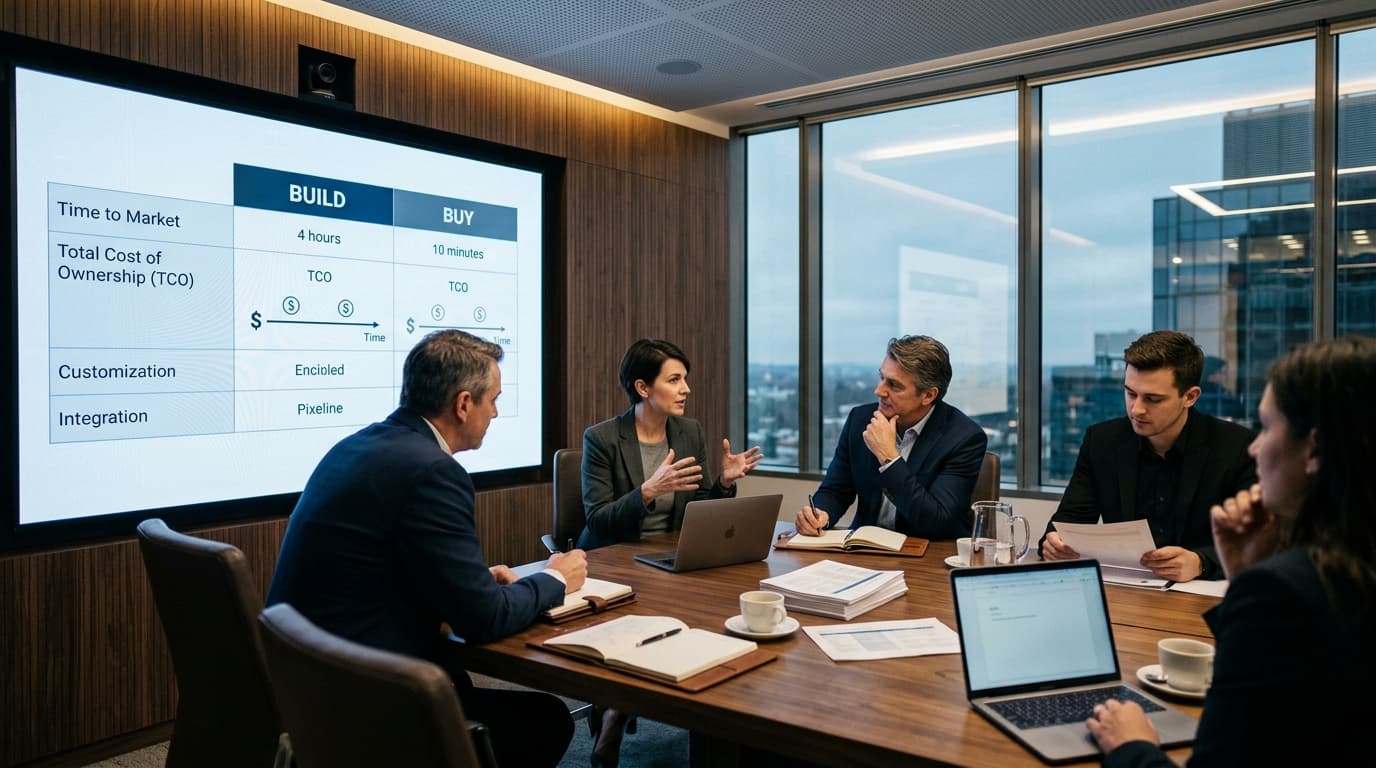
The Core Competency Matrix
Every leadership team eventually confronts the Build vs. Buy dilemma. Building custom software requires upfront capital and engineering commitment, while buying commercial off-the-shelf (COTS) software commits the business to recurring seat licenses and rigid vendor roadmaps.
The fundamental rule of technology strategy is simple:
- Buy for Commodity & Context Operations: Payroll, general ledger accounting, email hosting, standard HR administration, and help desk ticketing do not differentiate your business in the marketplace. Buy standard market-leading SaaS.
- Build for Differentiating Core Capabilities: The proprietary workflows, custom client portals, algorithmic pricing models, and specialized logistics engines that define your competitive edge should be owned and engineered in-house.
Calculating True Total Cost of Ownership (TCO)
When calculating TCO over a 3-to-5-year horizon, standard license sticker prices are only the tip of the iceberg:
- SaaS Hidden Costs: Per-seat fee inflation (15-30% annual renewal increases), mandatory enterprise tiers for SSO/audit logs, costly professional services for minor workflow changes, and operational inefficiencies from fitting your business into another vendor's opinionated mold.
- Custom Software Realities: Upfront discovery and development, cloud hosting, ongoing security patching, and continuous feature evolution.
The Commercial SaaS Customization Trap
A dangerous middle ground is buying a standard SaaS platform and spending hundreds of thousands of dollars heavily hacking its proprietary scripting language to behave like custom software.
This frequently yields the worst of both worlds: high recurring subscription fees combined with fragile, un-upgradeable customizations that break with every vendor release. If an off-the-shelf platform requires more than 20% modification to support your core workflow, custom software engineering on modern composable foundations is almost always more cost-effective.
The Composable Hybrid Alternative
Modern software development is rarely an absolute choice between 100% custom from scratch or 100% monolithic SaaS.
The most successful organizations adopt a Composable Architecture:
- License battle-tested, API-first primitives for commodity building blocks (e.g., Stripe for payments, Auth0 for identity, AWS S3 for storage, SendGrid for transactional email).
- Engineer bespoke frontend portals and proprietary orchestration logic tailored precisely to your customers and internal workflows.
Executive Evaluation Checklist
Before signing an enterprise SaaS contract or commissioning custom software, evaluate these three questions:
- Does this process represent why our customers choose us over competitors?
- Will this workflow change rapidly as our commercial model evolves over the next 24 months?
- Do we need complete ownership of the underlying data structure and IP?
If you answer "Yes" to two or more, engineering a tailored solution will yield superior long-term ROI and operational autonomy.